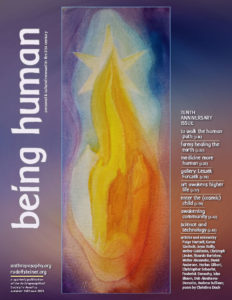
Marian Leon, the Anthroposophical Society in America's Administrative Director, is featured along with the society and its work on the cover of the Crazy Wisdom Community Journal, a substantial and long-running publication based in Ann Arbor and serving Southeastern Michigan. Inside a six-page article pictures the society's beautiful national office at Rudolf Steiner House.
The journal is one of the services of the Crazy Wisdom Bookstore and Tearoom, the center in this lively university city for spirituality, alternative health, progressive living and social consciousness. The bookstore hosted a series of talks in 2011, Rudolf Steiner's 150th year, on related initiatives, and Ann Arbor features a strong Waldorf School, the Rudolf Steiner Health Center, a biodynamic Community Farm, and the Great Lakes Branch of the society. Each issue of the CW journal presents a cover story on an influential local leader. [Read the article here...]

In his latest E-News, Mark McAlister, administrator for the Anthroposophical Society of Canada, writes about learning anthroposophy from non-anthroposophists. As some ironic types like to say, "What a concept!" But seriously, Mark writes:
"It’s been said that Alcoholics Anonymous makes it a principle to venerate newcomers. Their questions are sharp and immediate, and they prevent the organization from becoming complacent and irrelevant. Is there a lesson here for the Anthroposophical Society? What would happen if we paid more attention to the questions and concerns of newcomers?
"With this in mind, I decided to participate in the Cambridge Music Conference in Vancouver last November. Elizabeth Carmack (an anthroposophist) was the driving force behind the conference, but the vast majority of the presenters and participants had no direct connection with Anthroposophy. What brought them together was a deep concern for the plight and trauma of people in the justice system (including both perpetrators and survivors of violent crime), and a quest for real and sustainable healing. Nigel Osbourne (a composer from UK) was a particularly inspiring example. Working with children in war zones, he has shown how the elements of music can reach to the deepest levels of the human being and bring hope where otherwise there would only be despair. I did not feel that he was lacking anthroposophy; he was revealing it to me.
"One can have similar experiences in meetings of the biodynamic movement. I have met a number of young farmers in recent years..." [Keep reading...]
Among the Renewal Course offerings next month at the Center for Anthroposophy in Wilton, NH, is a week co-sponsored by the Anthroposophical Society in America with Rudiger Janisch and Penelope Baring, representatives of the general section of the School for Spiritual Science.
The course is for members of the Anthroposophical Society who inspire their daily lives and work through anthroposophical meditative practice and who might see their inner work leading to join the School for Spiritual Science.
It is also for members of the School for Spiritual Science who wish to deepen their understanding of the task and mission of the General Anthroposophical Section as given by Rudolf Steiner. The guidance for this course is taken from the path of meditative practice in the First Class. [Read more...]
April 22, 1970 was the first "Earth Day." John Beck pulls together a few of the connections, notably between eurythmist and biodynamic farmer (and translator and teacher and mentor) Marjorie Spock (1904-2008) and Rachel Carson (1907-1964), the author of Silent Spring. That book, like Uncle Tom's Cabin over a century before, created a revolution in attitudes about our relationship with and responsibility toward our planet. Rudolf Steiner's anthroposophy enlarges and deepens the background of environmentalism while providing tools like Goethean science and biodynamic agriculture to understand the Earth and heal it. [Read more...]
A bonus comes in the form of a poem by Daisy Aldan, "Earth is a Being Who Deserves to Be Loved." If this was not written with Earth Day in mind, it should have been. It was published in The Threefold Review and later in Threshold from Anthroposophy NYC. Its central lines present an unforgettable global image of Earth that joins with Rachel Carson's vision of a spring without birdsong:
Multiple is she in anger and reverence,
passion and prayer. Even in catastrophe
and tempest, confounding harmonies enlighten.
She is haloed with many balancing haloes,
each day crowned with a corona of caroling
as bird-note meets bird-note at dawn moving westward.

The annual general meeting of the General Anthroposophical Society takes place each year in Dornach, near Basel, Switzerland, at the Goetheanum, this year March 22-24. A report by US General Secretary Torin Finser was sent out on March 31st [read it here]. Additional news is now available in several upbeat articles in the latest Anthroposophy Worldwide. Seija Zimmermann was reconfirmed as a member of the Executive Council and Joan Sleigh was approved as a new member. Virginia Sease presented an appreciation of Sergei Prokofieff, "honoring his wish to keep it simple."
Some credit for the amity of this year's annual meeting is given to the fact that it was prepared for the first time by the Executive Council working together with a members’ group. For the future, "a working group (that includes Executive Council members Paul Mackay, Justus Wittich and Seija Zimmermann) has been formed with the goal of discovering a new form for our Annual General Meetings. The starting point for this cooperative effort is our shared feeling of dissatisfaction with the fact that the consideration of motions has taken up a significant amount of time during the Annual General Meetings, and that concentration on motions has had a strong impact on the entire Annual Meeting. Much of what lives within the Anthroposophical Society—positive, constructive, and innovative elements—is lost from sight and cannot be developed further. It has also been impossible to consider the very issues, concerns, or new ideas introduced by the motions themselves." [Read more in Anthroposophy Worldwide...]
The Isenheim Altar: an artistic approach to the Festival of Whitsun
Sat, May 18 2013 to Mon, May 20 2013Location: Angus, Ontario, CANADA
Sponsored by the Novalis Project in Ontario [more]
From Babel to Pentecost and Onward
Mon, May 20 2013 7:00 PM to 9:00 PMLocation: New York, NY
Lecture by Walter Alexander at Anthroposophy NYC [more]
The Mysteries of the Heart: The Pulse of Freedom
Thu, May 23 2013 8:00 PMLocation: Silver Springs, MD
2012-13 Esoteric Christianity Series [more]
Know Thyself: The Search for a Healing Balance Between Extremes
Sat, May 25 2013 to Sun, May 26 2013Location: Hardwick, VT
The 22nd Heartbeet Conference [more]
The Courage To Be
Sat, Jun 01 2013Location: Chestnut Ridge, NY
One-day Clowning Workshop with Angie Foster [more]
Three recent postings in our articles section are worth a look. John Miller reviews Partnerships of Hope, an account by Christopher Schaefer of the challenges and successes of building a Waldorf school community. Leah Walker writes about the "threshold work" which is so important to the "biography and social art" inspired by anthroposophy. And Chris Schaefer praises the Doris Kearns Goodwin biography of Lincoln, on which the recent Steven Spielberg movie was partly based, for its illumination of karmic relationships. Read on...
Last week the Associated Press featured the Rudolf Steiner Fellowship Community in Chestnut Ridge, NY, under the headline "For the aging, a commune-like alternative in NY." Appearing on websites and newspaper pages across the country, the story is a friendly and accurate description of the life and intentions behind this remarkable community focused on the needs of the aging. "Commune-like" is the lead phrase, but later the thought emerges that this is how life in a large family used to be, with people of all ages present and engaged, and the elders both giving and getting help freely according to ability and need.
"'It's a great place to live, and I think there's probably no better place in the world to die,' says Joanne Karp, an 81-year-old resident who was supposed to be in her room recovering from eye surgery but instead was down the hall at the piano, accompanying three kids learning to play the recorder." "Larry Fox, 74, a psychologist, treats patients at the Fellowship's medical office and said, 'Where could I be at my age and be so happy to get up in the morning and look forward to the day?'"
Read the full article here at ABC News. And the community's own website has a lot more to share: www.fellowshipcommunity.org
The theme for the year 2013-2014 was recently published in Anthroposophy Worldwide, and was written for the Goetheanum leadership by Christiane Haid, who was chosen last year to head the Section for the Literary Arts & Humanities of the School for Spiritual Science.
"Following on the question of 'The Identity of the Anthroposophical Society' (the theme for 2012), we turn to the development of the human I in 2013. The individual I is both the eye of the needle and the focal point that serves to form our community and society--indeed, all of the circumstances around us." Continue reading...

The first issue for 2013 of Anthroposophy Worldwide brings a translation of Sergei Prokofieff's letter on his work and health. With the annual general meeting March 22-23 he will move to emeritus status on the Executive Council at the Goetheanum, and will have to curtail his speaking and communications activities due to complications of his illness. His anthroposophical research work continues, and two further books are soon to be published, and he thanks friends around the world for their expressions of support and good wishes.
Along with the new issue of Anthroposophy Worldwide comes a winter scene from the Goetheanum neighborhood in Dornach, Switzerland.
The Anthroposophical Society was founded by Rudolf Steiner in Switzerland in 1923. It seeks to support individuals who are working on their own inner development and who wish to bring the fruit of that inner work to benefit the wider world. More...
E-NEWS:
sign up or read back issues
MEDITATION & SPIRITUAL PERCEPTION - volume 10 of the "Classics from the Journal for Anthroposophy" is now available, and you can purchase the complete set!
Anthroposophical Society in America
1923 Geddes Ave
Ann Arbor, MI 48104-1797
Tel: 734.662.9355
Fax: 734.662.1727
Email: info (at) anthroposophyorg